RTE international, AFD and MEPSO: a partnership driving energy performance in North Macedonia
Paris, April 2026. In partnership with the AFD (Agence Française de Développement), RTE international has completed a technical assistance programme for North Macedonia’s TSO, MEPSO. Running alongside an engineering pilot project to digitalise a power substation, the programme addresses three areas of power system planning and operation: security of supply, medium-term reserve sizing, and transmission lossforecasting. To meet the TSO’s requirements, RTE international drew on a broad range of expertise spanning power systems expertise anddigital innovation.
Open-source tools to strengthen security of supply
RTE international developed a bespoke Antares Simulator model for the North Macedonian network, encompassing all European countries. A benchmark open-source tool for modelling and simulating generation dispatch, it enabled MEPSO to publish its first National Resources Adequacy Assessment (NRAA), which is now undergoing validation by the national regulator. This publication marks a significant regulatory milestone: a legal requirement for many European TSOs, it also bolsters MEPSO’s credibility within the wider European energy community.
By integrating Antares Simulator into its planning practices, MEPSO joins the tool’s growing user community and gains a robust, long-term application for conducting annual security-of-supply studies in line with European standards.
Machine learning to anticipate reserve requirements
Reserve sizing was an area of priority for MEPSO. Whereas the methodology applied at European level focuses on sizing reserves for the coming year based on analysis of the previous year’s imbalances, the study conducted in the North Macedonian context takes a longer view, projecting forward three to five years.
To meet this specific need, RTE international developed a brand-new methodology. Built on a predictive model using machine learning, the approach analyses historical imbalances alongside contextual data, including consumption, solar irradiance, and cross-border flows, before projecting future reserve requirements based on system characteristics such as installed renewable energy capacity and demand trends through to 2028–2030. RTE international also shared French experience in system balancing through a dedicated training workshop and a detailed technical report.
Supporting loss forecasting and procurement
Network losses represent a significant cost for any TSO. RTE international supported MEPSO in revising its methodology for forecasting and procuring losses, with the aim of reducing associated expenditure. Drawing on historical loss data, forecasting records, and other contextual inputs, RTE international assessed the quality of MEPSO’s existing forecasting methods and put forward several alternatives. Two approaches were selected: the first balances ease of implementation with incremental gains; the second, more complex and machine learning-based, offers more substantial improvements in forecast accuracy.
In addition, RTE international recommended several enhancements to MEPSO’s loss procurement strategy, drawing on RTE’s own practices in France.
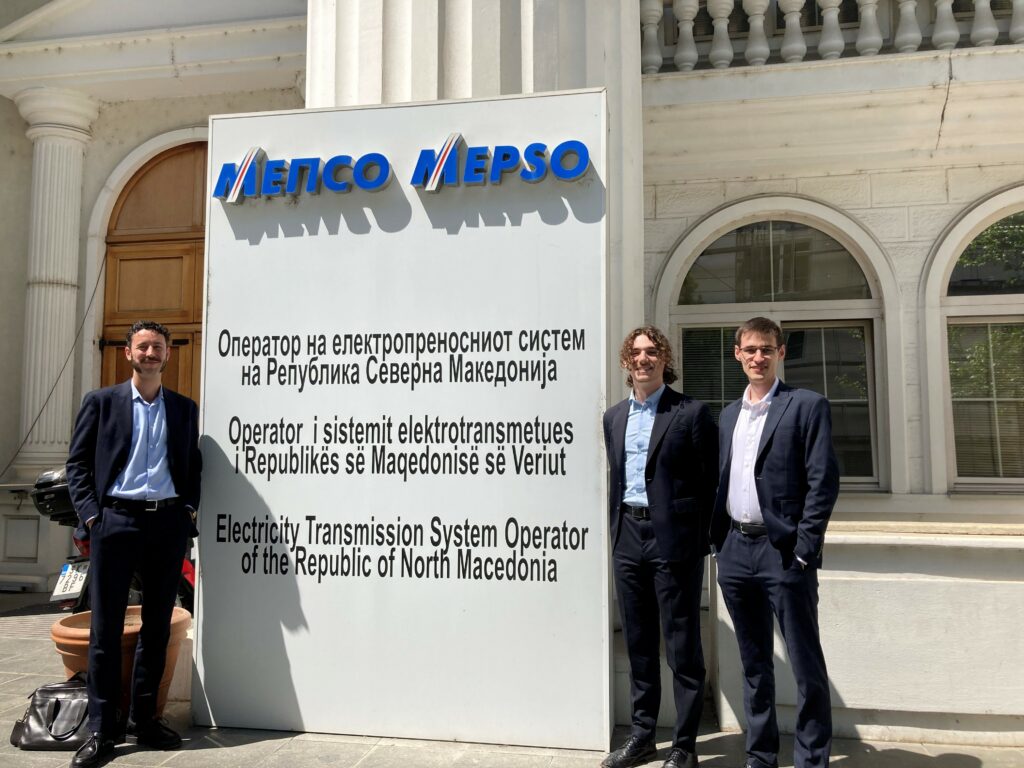
RTE international’s foothold in the Balkans
Alexandre Périn, Project Manager, commented:
“In a context where European standards and methods serve as the benchmark for power system management, every project RTE international carries out to bring its clients closer to those standards reinforces our position as a trusted technical partner, capable of addressing complex challenges with a multidisciplinary and tailored approach. This project also forms part of RTE international’s regional development strategy in the Balkans, a key region for the European energy transition, where we are established through our subsidiary RTEi South-East Europe.“
François Vince, Deputy Director of the Western Balkans Agency, added:
“The ongoing energy crisis is a daily reminder of how interconnected European electricity networks strengthen our collective resilience. Connecting Western Balkan countries to one another and to the rest of Europe is therefore a critical step towards energy sovereignty, both for the region and for Europe as a whole. This ambition is advanced by the collaboration between RTE International and MEPSO, as well as by the peer-to-peer partnerships RTE International is conducting in Montenegro, Kosovo, and Serbia. The AFD is proud to support this work, which contributes to building a stronger European electricity market and to accelerating the energy transition across the Western Balkans.”
MEPSO’s expressed satisfaction with the programme confirms this positive trajectory and opens new avenues for future cooperation.
Branka Vasikj, Senior Strategic Planning Engineer at MEPSO, testified:
“Through our cooperation with RTE International, MEPSO received highly valuable technical support and knowledge transfer in several key areas for the future development of our power system. With their expertise and the use of the Antares Simulator, we successfully prepared our first Adequacy Study, which represents an important milestone for MEPSO. This partnership is valued not only for the reports produced, but also for the lasting impact of the knowledge shared, which strengthens MEPSO’s internal capacities and supports its path towards a more resilient and future-ready power system aligned with international best practices.”